Explain Finance Concepts: Financial Education Videos
How to explain finance concepts like interest, budgeting, inflation and loans in plain words, with checked examples and a financial education video outline.
Put 1,000 dollars in a savings account paying 5% a year, leave the interest in, and after three years you have 1,157.63 dollars. Most people can follow that sentence. Few can follow "compound interest is interest calculated on the initial principal and the accumulated interest of prior periods". That is the whole method for explaining finance concepts: one real-looking number, followed step by step, before any definition.
This guide applies it to interest, budgeting, inflation and loans, for customers, students or staff. Every example uses round numbers that have been checked, and it ends with how to stay clear of advice and a two-minute outline to copy.
Three rules for explaining money
Follow one example the whole way. Pick one amount and one person and stay with them. Switching from 1,000 to 5,000 to "a percentage of your balance" in one explanation loses people.
Show the number change, then name it. Say "the second year, you earn interest on 1,050, not 1,000" and only then say "that is compounding". The word sticks better once the viewer has seen what it describes.
Explain, do not recommend. "Here is how a longer loan changes the monthly payment" is education. "You should take the longer loan" is advice. More on this below.
Explaining interest: simple and compound
Start with interest as a price: the price of using someone else's money. When you borrow, you pay it. When you save, the bank pays you.
Then show the difference between simple and compound interest with the same 1,000 dollars at 5% a year:
| After | Simple interest (5% of 1,000 each year) | Compound interest (5% of the new balance each year) |
|---|---|---|
| 1 year | 1,050.00 | 1,050.00 |
| 2 years | 1,100.00 | 1,102.50 |
| 3 years | 1,150.00 | 1,157.63 |
| 10 years | 1,500.00 | 1,628.89 |
The script almost writes itself: "In year one, both earn 50 dollars. In year two, the compound account earns 5% of 1,050, which is 52.50. The extra 2.50 is interest on interest. After ten years, the gap is nearly 129 dollars, from the same deposit and the same rate."
Real accounts often compound monthly or daily, which makes the total a little higher. For teaching the idea, yearly is easier to follow; say that it is simplified.
Explaining budgeting: where each dollar goes
Budgeting is easier to explain as a plan for money you already have than as cutting back. A common starting rule splits take-home pay into three parts: 50% for needs, 30% for wants and 20% for savings or paying off debt.
Use one take-home amount, say 2,400 dollars a month:
- Needs, 1,200: rent, utilities, groceries, transport to work, minimum loan payments.
- Wants, 720: eating out, streaming, new clothes beyond the basics.
- Savings and extra debt payments, 480: an emergency fund first, then other goals.
Three jars are the picture people remember. Say plainly that the split is a starting point: where rent alone takes half of take-home pay, the needs jar will be bigger, and that is a constraint, not a failure.
Explaining inflation: the same money buys less
Inflation is the general rise in prices over time, so the same amount of money buys a little less each year.

The basket example is the clearest:
- A basket of groceries costs 50 dollars this year.
- Prices rise 4% over the year.
- Next year, the same basket costs 52 dollars.
Turn it around for savings: 1,000 dollars kept as cash for that year now buys only about 962 dollars' worth of last year's shopping (1,000 divided by 1.04). Then connect it to interest: a savings account paying 3% while prices rise 4% still leaves the saver with about 1% less buying power.
Use made-up round rates like these when teaching the idea, and say so. If you quote your country's actual inflation rate, take it from the official statistics office and say the month it applies to, because it changes.
Explaining loans: payments, interest and the length of the loan
Most people know their monthly payment and little else. Three ideas cover most of what they need.
1. Each payment has two parts. Take a loan of 10,000 dollars over three years at 8% a year, repaid monthly. The monthly payment is about 313.36 dollars. In the first month, about 66.67 dollars of that is interest (8% divided by 12, times 10,000) and about 246.70 dollars pays down the loan.
2. The interest part shrinks over time. In month two, interest is charged on the smaller balance of about 9,753.30, so it falls to about 65.02 and more of the payment goes to the loan. By the last payments, almost all of it is paying down the balance.

3. A longer loan means a lower payment but more interest in total. Same 10,000 dollars, same 8%:
| Length | Monthly payment | Total repaid | Total interest |
|---|---|---|---|
| 3 years (36 payments) | 313.36 | 11,281.09 | 1,281.09 |
| 5 years (60 payments) | 202.76 | 12,165.84 | 2,165.84 |
The longer loan costs about 885 dollars more in interest, in exchange for a payment about 111 dollars a month lower. Neither is "right"; the point is that the viewer can see the trade.
Lenders also quote an annual percentage rate (APR), which in many countries must include certain fees as well as interest, so loans can be compared on one number. Check what your country's rules include before you explain it.
Keep it education, not advice
Financial education explains how things work. Financial advice tells a particular person what to do with their money. Videos for customers, students or staff should stay on the education side unless the person making them is qualified and permitted to advise.
In practice:
- Use "for example" numbers, not "if you earn what you earn".
- Avoid "should" about products. "A longer loan lowers the payment and raises the total interest" rather than "choose the longer loan".
- Name no investment as a good buy. Explain how a type of product works, including its risks.
- Say it on screen. A closing line such as "This video explains how loans work. It is not advice for your situation" sets the right expectation.
- Get it approved. Banks, lenders, insurers and advisers usually have rules on financial promotions, and their compliance team should approve the script before anything is published.
Worked example: a two-minute loan explainer for customers
A credit union, a lender's help centre or a school finance class could use this. It teaches one idea: why the same loan costs different amounts over different lengths.
Learning goal: after watching, the viewer can explain why a longer loan has a lower payment and a higher total cost.
Outline you can copy (about 300 words of narration):
- The question. Sam needs to borrow 10,000 dollars for a car. The lender offers three years or five years, both at 8% a year.
- What a payment is made of. Each monthly payment has two parts: interest, the price of borrowing, and the part that pays down the loan.
- Month one. On the three-year loan, Sam pays about 313 dollars. About 67 is interest; about 247 pays down the loan.
- Over time. As the balance shrinks, so does the interest. More of each payment goes to the loan.
- The five-year option. The payment drops to about 203 dollars a month. Easier each month.
- The total. Over three years Sam repays about 11,281 dollars; over five years, about 12,166. The longer loan costs about 885 dollars more in interest.
- The trade. Lower payments, higher total cost. Which matters more depends on Sam's budget.
- Close. This video explains how loan payments work. It is not advice for your situation.
Prompt to copy into an AI video tool:
Make a 2-minute whiteboard explainer for customers on how loan length changes the cost of a loan. Use one example: Sam borrows 10,000 dollars at 8% a year. Compare 3 years (about 313 dollars a month, about 11,281 repaid in total) with 5 years (about 203 dollars a month, about 12,166 in total). Explain that each payment is part interest and part repayment. Plain, neutral tone; do not recommend either option. End with: "This video explains how loan payments work. It is not advice for your situation."
Give the AI the numbers rather than asking it to calculate them, and check every figure in the finished video.
Making a finance explainer with KolaVid
KolaVid turns a typed prompt, pasted text or script, a PDF, Word, PowerPoint or text file, or a web link into a narrated whiteboard video. Each drawing appears as the narrator says it, one idea a board, which suits finance: the 10,000 dollars, then the payment, then its two parts, in the order they are explained.
Paste the prompt above, or attach a product guide or lesson plan with Add a document and say which concept to explain for whom. Then choose the Hand-drawn style, a length, a voice and a narration language.
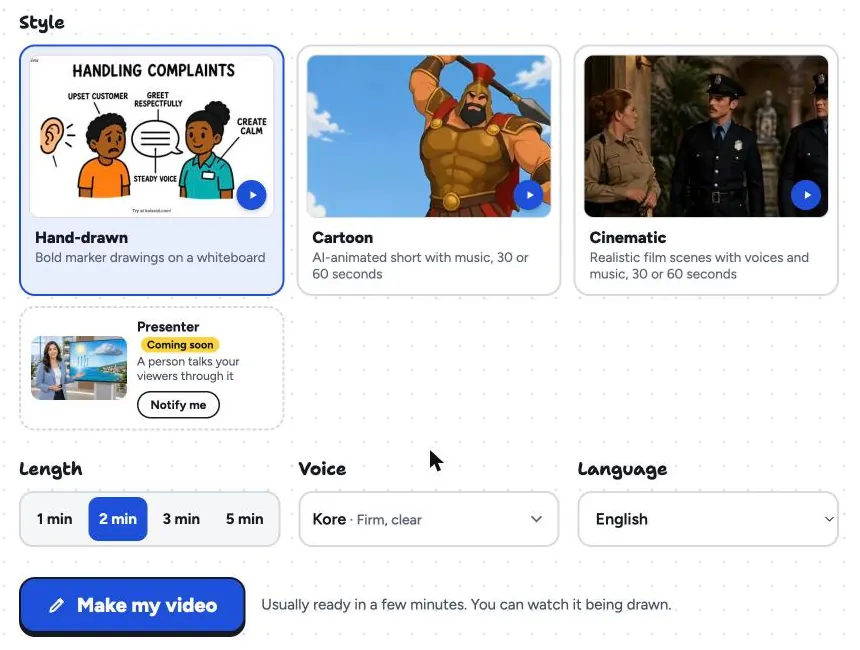
Free videos go up to 2 minutes and paid plans up to 5. It is usually ready in a few minutes, and you can watch it being drawn. Watch it once against your numbers before sharing; there is no editing timeline, so a wrong line means correcting the script and making it again. Download the MP4 or share a link.
For staff topics like benefits or expense rules, the training page and our guide to employee onboarding videos help. For a classroom series, see whiteboard videos for teachers, and for writing the script yourself, the script to whiteboard video guide.
FAQ
How do you explain compound interest simply?
Follow one amount for a few years. 1,000 dollars at 5% a year earns 50 dollars in year one; in year two it earns 5% of 1,050, which is 52.50. Interest earning interest is compounding.
How long should a financial education video be?
Two to three minutes for one concept, such as inflation or how a loan payment works. A series of short videos is easier to rewatch than one long lesson that covers everything.
Can a financial education video give advice?
It should explain, not advise. Use example numbers, avoid telling viewers what to choose, add a line saying it is not advice for their situation, and have a qualified or compliance reviewer approve it if you work for a financial firm.
Should finance explainer videos use real rates?
Round example rates are clearer for teaching the idea. If you quote a current rate, such as inflation or a product's interest rate, give the source and the date, and update the video when it changes.
Start with the question you hear most
Pick the money question your customers, students or staff ask most often, follow one round example from start to finish, and check every number twice. If you want to make it a video without recording yourself, a free KolaVid account includes enough credits for one 2-minute video, no card needed.