History Lesson Videos: How to Teach History with Video
How to make a history lesson video: ask one question, tell it as cause and effect, keep the timeline short and check every date. Berlin Wall example inside.
A good history lesson video answers one question, not one period. Pick a question with a real answer, such as "Why did the Berlin Wall open in 1989?", tell it as a chain of causes and consequences in the order they happened, and check every date and name against two reliable sources before anyone watches. Two to four minutes is enough; the rest of the period belongs to the lesson around the video.
That is the short version of how to teach history with video. Below: choosing the question, building cause and effect, storytelling without invention, and a worked Berlin Wall example with an outline and prompt to copy.
Start with a question, not a topic
"The Cold War" is a topic. "Why did the Berlin Wall open on the night of 9 November 1989?" is a question, and it gives the video a direction and an ending.
Questions that work well in a short video:
- Why did the Berlin Wall open in November 1989?
- How did the printing press change the way ideas spread in Europe?
- Why did the Roman Republic end up ruled by emperors?
A simple test: write the answer in one or two sentences. If you cannot, the question is too wide. Narrow it to one place, one turning point or one decision, and save the rest for another video.
Build the story as cause and effect
A list of events teaches sequence. History asks for more: why one thing led to another. The easiest way to show that in a video is a chain with four kinds of link.
- Background: the situation before anything changed.
- Long-term pressures: the slow forces that made change likely.
- The trigger: the event that turned pressure into action.
- Consequences: what happened next, and why it still matters.
Join each link with "because" or "so", never just "and then". "The economy fell behind, so more people wanted to leave" is an explanation. "The economy fell behind, and then people left" is a list.
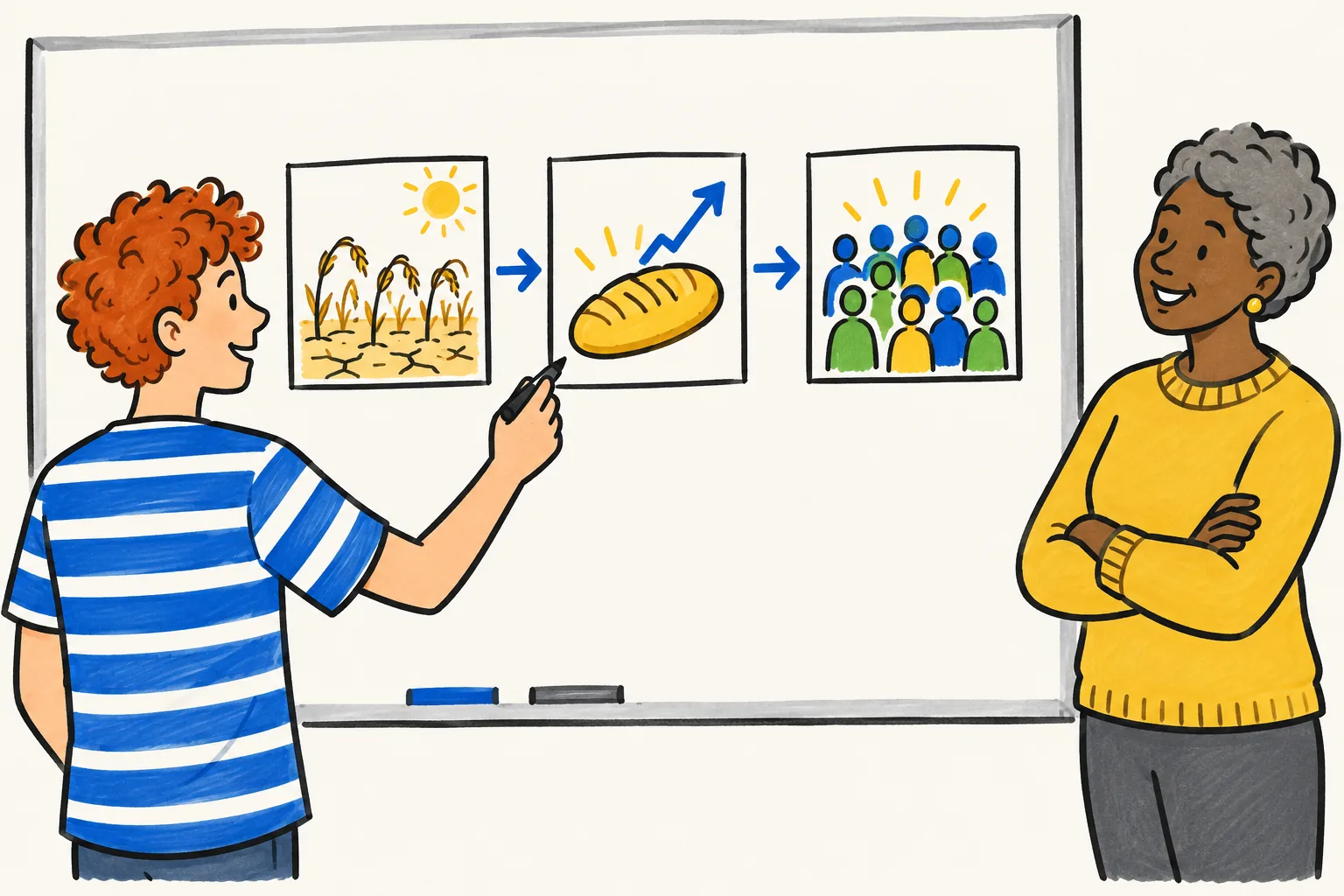
This is where a drawn video earns its place. Each cause can be a simple picture and each "because" an arrow, so the viewer sees the chain build up. Keep one link per board.
Separate long-term causes from the trigger. Students often name the trigger as "the cause" and stop. A video that shows both, then asks which mattered most, gives them something to argue about, which is what historians do.
Keep the timeline short
Videos are bad at dates in bulk. A viewer will not hold thirty dates from a three-minute video, and they should not need to. Choose four to six dates that carry the story and leave the rest in the worksheet or textbook.
A few rules that help:
- Say each date the same way every time. "9 November 1989", not "November ninth" in one scene and "the ninth" in the next.
- Be exact where it matters, round where it does not. "In the late 1980s" is fine for a background trend. The day the border opened needs the real date.
- Tell it in order. Start with a flash-forward hook if you like, but say clearly when you jump back.
Tell a story without inventing facts
Stories make history memorable, and they are where most mistakes creep in. These rules keep the story honest:
- No invented dialogue or thoughts. If someone speaks in your video, quote a real source and say who said it. Do not write what a historical figure "must have felt".
- Label anything imagined. "Imagine a family in East Berlin watching the news that evening" is fine, because the word "imagine" tells the viewer it is a device, not a record.
- Say when historians disagree. "Historians still argue about how much this mattered" is more truthful than a neat single cause, and it invites discussion.
- Mind hindsight. People at the time did not know how things would end.
- Use ranges for uncertain numbers. Crowd sizes and casualty figures are often estimates. Give the range your sources give, and say it is an estimate.
Check every fact against two sources
Every date, name and number in the script should be checked against two reliable sources: a recent textbook, a museum or archive website, a university page, or an encyclopedia written by named experts. Primary sources (a film of a press conference, a letter, a newspaper from the day) are the strongest evidence, but you still need a secondary source to read them correctly.

This matters even more if an AI tool helps write the script: language models can state a wrong date with complete confidence. Check an AI draft the way you would check a student's essay.
A fact-check table you can copy:
| Claim in the script | Source 1 | Source 2 | Agree? |
|---|---|---|---|
| Wall built from 13 August 1961 | |||
| Leipzig march, 9 October 1989 | |||
| Border opened, 9 November 1989 |
Put your main sources in the video description or on the worksheet, so students can see where the facts came from.
Worked example: why the Berlin Wall opened in 1989
Question: Why did the Berlin Wall open on 9 November 1989? Audience: students aged 14 to 16 who know what the Cold War was. Length: three minutes.
The dates used, checked before writing (against the City of Berlin's history pages and the Berlin Wall Foundation, plus a textbook):
- 13 August 1961: East Germany begins closing the border in Berlin; the wall is built and strengthened over the following years.
- 2 May 1989: Hungary begins taking down the fence on its border with Austria.
- 11 September 1989: Hungary lets East Germans cross into Austria, and thousands leave.
- 9 October 1989: about 70,000 people march peacefully in Leipzig (sources give 70,000 or more).
- 18 October 1989: Erich Honecker is replaced as East German leader.
- 9 November 1989: at an evening press conference, the government spokesman Günter Schabowski announces new travel rules and says that, as far as he knows, they take effect immediately. Crowds gather at the border crossings, and later that night the guards at Bornholmer Straße let people through.
- June 1990: official demolition of the wall begins.
- 3 October 1990: Germany is reunified.
Sources disagree on the exact minute of some events that evening, so the script says "that evening" and "later that night" rather than giving clock times.
Outline you can copy:
- Hook. The night of 9 November 1989: people walking freely through a border crossing that had been closed for 28 years. How did that happen in one night?
- Background. In 1961 East Germany built the wall to stop its people leaving for the West.
- Long-term pressure. East Germany's economy fell behind the West's, and many people wanted to travel and could watch West German television. Pressure built for years.
- A crack elsewhere. In 1989 Hungary opened its border with Austria. Thousands of East Germans left that way, so the wall no longer stopped people leaving.
- Pressure at home. On 9 October about 70,000 people marched in Leipzig, and security forces did not stop them. Nine days later, Honecker was replaced.
- The trigger. On 9 November a spokesman announced new travel rules and said they applied immediately. That was not what the government had planned.
- The night. Crowds gathered at the crossings. Guards without clear orders faced thousands of people, and at Bornholmer Straße they opened the gate.
- A common mistake. The wall was not torn down that night. People chipped pieces off it, and official demolition began in June 1990. Germany was reunified on 3 October 1990.
- The answer. Years of pressure, Hungary's open border and peaceful protest made change likely. A confused announcement decided the night it happened.
- Question for the class. Which cause would you rank first, and why?
Prompt you can copy:
Make a 3-minute history lesson video for students aged 14 to 16 that answers: why did the Berlin Wall open on 9 November 1989? Tell it as cause and effect in the order things happened: background, long-term pressures, Hungary's open border, the Leipzig march, then the announcement that triggered the opening. Use only these dates: [paste your checked list]. Do not invent dialogue or quotes. Explain that the wall was not torn down that night. End by asking which cause mattered most.
Making a history video with KolaVid
KolaVid turns a typed prompt, pasted text or script, a PDF, Word or PowerPoint file, or a web link into a narrated whiteboard video. Each drawing appears as the narrator says it, with one idea on each board, which suits a chain of causes: one cause, one board.
Paste the prompt above, or paste your outline as a script. Then pick the Hand-drawn style, a length, a voice and the narration language. Free videos run up to 2 minutes, so for a free video drop steps 3 and 5 or merge them; paid plans go up to 5 minutes.
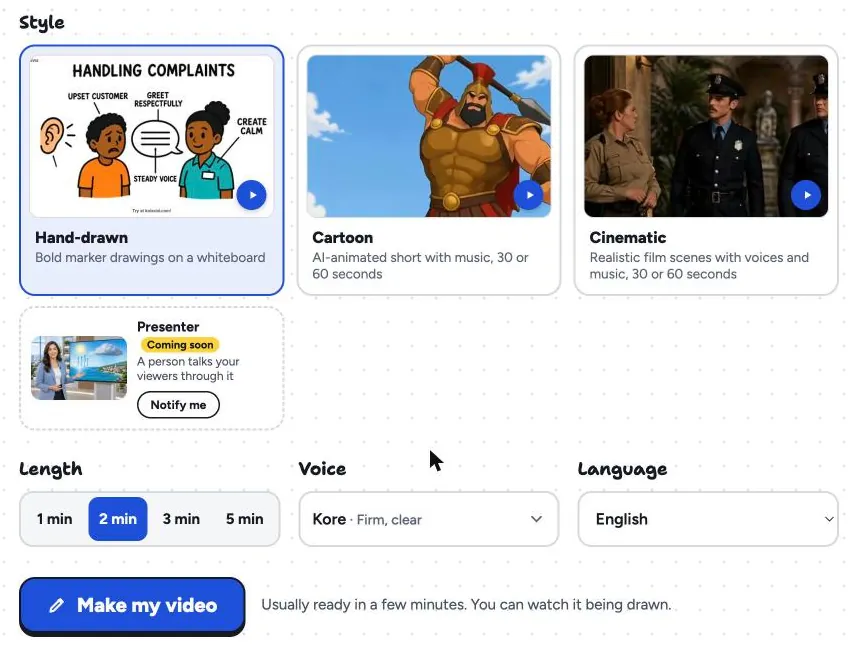
It is usually ready in a few minutes, and you can watch it being drawn. Then watch it once more with your fact-check table beside you. There is no editing timeline, so if a date or a name is wrong, correct your prompt or script and make it again. Download the MP4 for your slides or learning platform, or share a link with the class. The teachers page has sample lessons, and our guide to prompt-to-video lessons covers how to word a prompt.
FAQ
How long should a history video be?
Two to four minutes for one question. If you need more, make a short series, one question each.
Can I use AI to write a history lesson script?
Yes, as a first draft. Then check every date, name and number against two reliable sources, remove anything invented (especially quotes and feelings), and add the sources to your description. The checking is your job, not the tool's.
How do I make history engaging without making things up?
Use real stakes and real sources. Open with a moment people can picture, show cause and effect clearly, and use "imagine" when you invent a scene so viewers know it is a device. Real history usually has enough drama without inventions.
Should a history video include primary sources?
Where you can, yes. A short line from a real document or a map of the time shows students what evidence looks like. Say what the source is and when it was made.
Start with one question
Pick the question your students find hardest to explain, check four to six dates, and make one short video that tells it as cause and effect. If you want to try it without recording your voice, a free KolaVid account includes one 2-minute video with no card needed. For more ideas on using video in class, see our guide to whiteboard videos for teachers, or turn a chapter you already have into a lesson with our document-to-video guide.