Nonprofit Explainer Video: Make an Awareness Video
How to make a nonprofit explainer or awareness video: one audience, one ask, honest figures on where donations go, stories told with consent. Outline inside.
A nonprofit explainer video has one job: help someone who has never heard of your work understand the problem, what you do about it, and one thing they can do next. Keep it to one audience and one ask, use numbers you can show in your accounts, and tell real people's stories only with their informed consent. Ninety seconds to two minutes is usually enough.
The same shape works for an awareness video about a cause, a video explaining one programme, or a video showing donors how their money is used. Below is the shape, the honesty rules that matter most for charities, and a worked example built around a fictional community garden, with an outline and a prompt you can copy.
Pick one audience and one action
A video for "everyone" ends up asking for everything: give, volunteer, share, sign, attend. Viewers do none of them. Decide first who is watching and what you want them to do afterwards.
| Audience | What they need to hear | One action |
|---|---|---|
| Possible donors | The problem, what you do, what a gift pays for | Give once or monthly |
| Volunteers | What a session looks like, what is expected, who they will meet | Sign up for a first session |
| The community you serve | What is offered, who it is for, how to get it | Come along, or call |
| Partners and funders | The approach, the results, what you need | Arrange a conversation |
If you need two of these, make two videos. Short videos cost little to make, and each one can be shared where that audience already is.
Use a four-part shape
Most nonprofit explainers fit this order:
- The problem, at human scale. Not "food insecurity affects communities" but "on our estate, some families skip meals at the end of the month".
- What you do, as plain steps a viewer can picture.
- What difference it makes, in honest terms: what you have done, not what you hope to do.
- The one action, with exactly where to go.
Spend most of the time on parts 1 and 2. People give and volunteer when they understand the work, and a clear picture of what happens on a Saturday morning does more than an adjective like "transformative".
Show where donations go, honestly
Donors often ask what their money pays for, and a short drawn explanation answers that well. It also carries risk, because a careless claim can mislead.
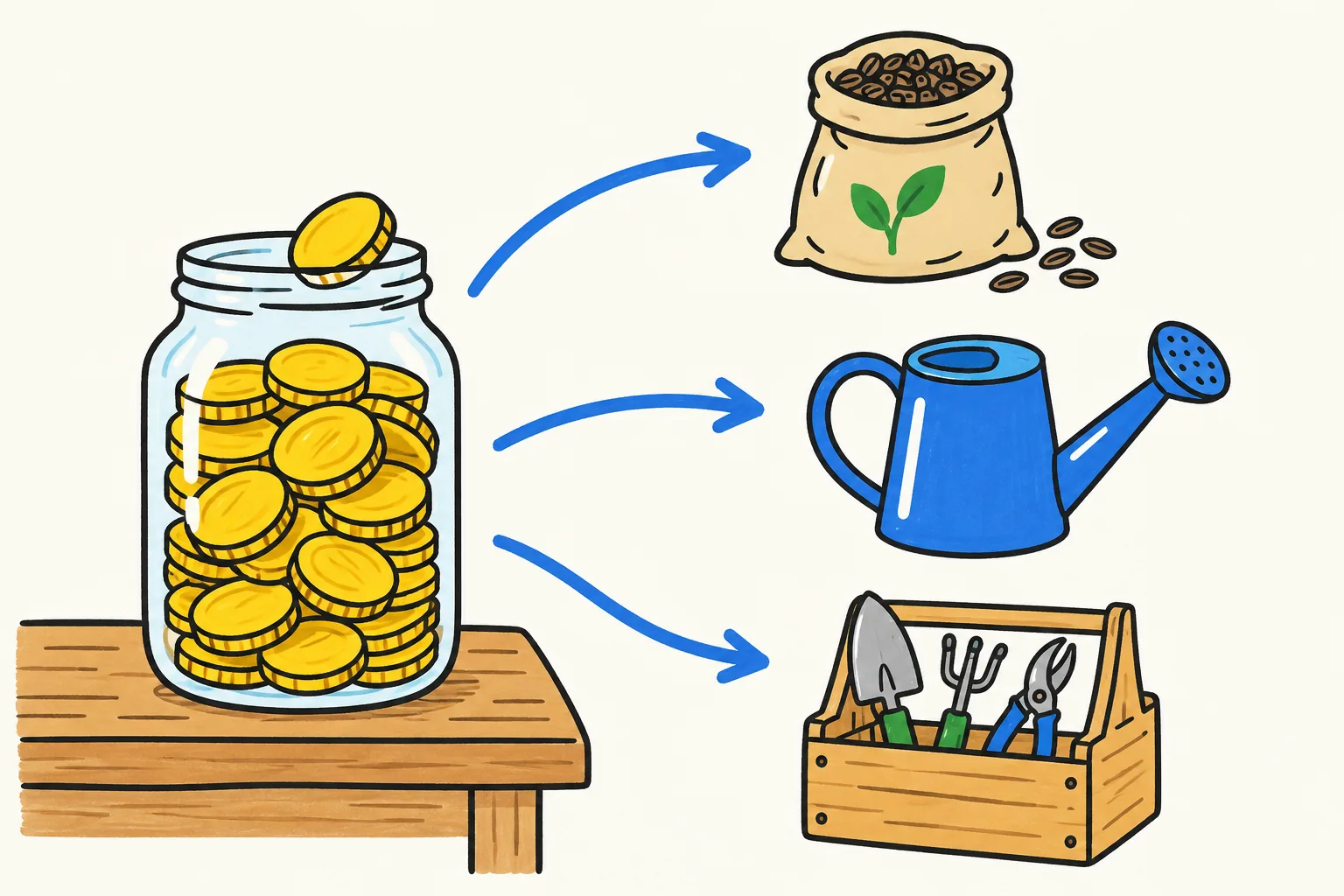
Rules that keep it straight:
- Use figures from your latest accounts, and say which year they are from.
- Say "for example" when you give a gift equivalent. "£20 could buy seeds for one bed for a season" is honest if the price is real. "Your £20 buys seeds" is a promise that the money goes to that exact item, which may not be true if gifts are pooled.
- Do not hide running costs. Insurance, a coordinator's hours and keeping the lights on are part of doing the work. Say so plainly rather than implying every penny goes straight to the front line.
- Separate restricted and general funds if you mention a specific appeal, so donors know what their gift can be used for.
- Link to your annual report or accounts in the video description.
Tell people's stories with consent and dignity
A real person's story is often the most powerful part of an awareness video. It is also where charities most often get things wrong.
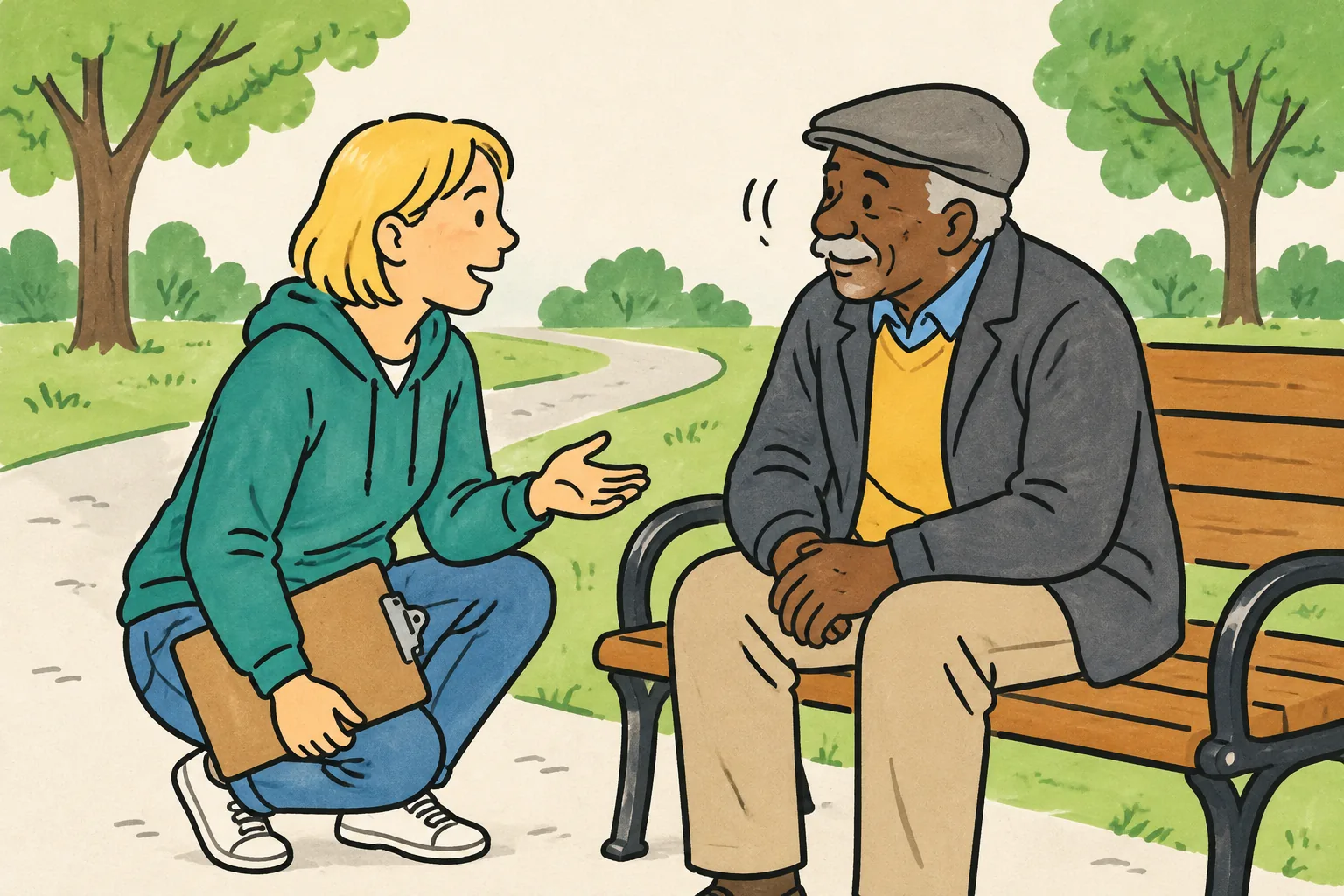
Before you use anyone's story:
- Ask for informed consent. Explain where the video will be shown, for how long, and who might see it. Make clear that saying no will not affect the help they receive.
- Let them withdraw. Agree how they can ask you to take it down later, and honour it.
- Get a parent's or guardian's consent for children, and think hard about whether a child's story needs to be told at all.
- Change details when needed. Use a different name and say so: "We'll call him Joe." A drawn video helps here, because nobody's face is shown.
- Label composites. If a story combines several people, say it is based on several people you work with.
- Let people describe themselves. Use their words for their situation, not pity language. Show what they did, not only what happened to them.
For awareness videos, source every fact
If the video raises awareness of a cause rather than a single programme, the facts carry the weight. Use figures from a named, reputable source, say the year, and do not round them up for effect. Local figures, where you have them, land harder than national ones. Put the sources in the description, and check every number again before publishing; a corrected video loses less trust than a challenged one.
Worked example: a fictional community garden
*This organisation and every number below are invented for the example. Replace them with your own, taken from your accounts.*
Organisation: the Eastgate Community Garden Trust (fictional), a small charity running two shared gardens in a town. Audience: possible monthly donors who live nearby. Ask: give £5 a month. Length: 90 seconds, square frame for social media and WhatsApp.
Facts sheet (example figures):
- Two gardens, open three days a week.
- About 40 volunteers grew vegetables last year; part of the harvest went to the local food bank.
- A weekly afternoon session for older residents who live alone.
- Last year's spending: about 60% on seeds, tools and water; about 25% on a part-time session coordinator; about 15% on insurance and administration.
Outline you can copy:
- The problem. In Eastgate, plenty of people have no garden, and some older residents can go days without a proper conversation.
- What we do. We run two shared gardens. Volunteers grow vegetables together, three days a week.
- Who it helps. Part of every harvest goes to the local food bank. And every Wednesday afternoon, older neighbours who live alone come to plant, drink tea and talk.
- One story, with consent. "We'll call him Joe. He was a bus driver for thirty years. Now he runs the tomato bed and teaches the new volunteers."
- Where the money goes. Last year, about 60% went on seeds, tools and water, about a quarter on the coordinator who runs the Wednesday sessions, and the rest on insurance and running costs.
- What £5 a month means. For example, it helps keep the Wednesday sessions running through the winter.
- The ask. Give £5 a month at the link below. Our accounts are there too.
Prompt you can copy:
Make a 90-second explainer video for a small community garden charity, for people living nearby who might give monthly. Use only the facts and figures in this outline: [paste outline]. Tell it warmly and plainly, without exaggeration or pity language. Joe is a changed name; say so. Show where the money goes as three simple parts. End with one ask: give £5 a month at the link in the description.
Making a nonprofit video with KolaVid
KolaVid turns a typed prompt, pasted text or script, a PDF, Word or PowerPoint file, or a web link into a narrated whiteboard video. Each drawing appears as the narrator says it, with one idea on each board, which suits the four-part shape above. You can paste the outline, or attach a programme leaflet or annual report with Add a document and say which part to explain and for whom.
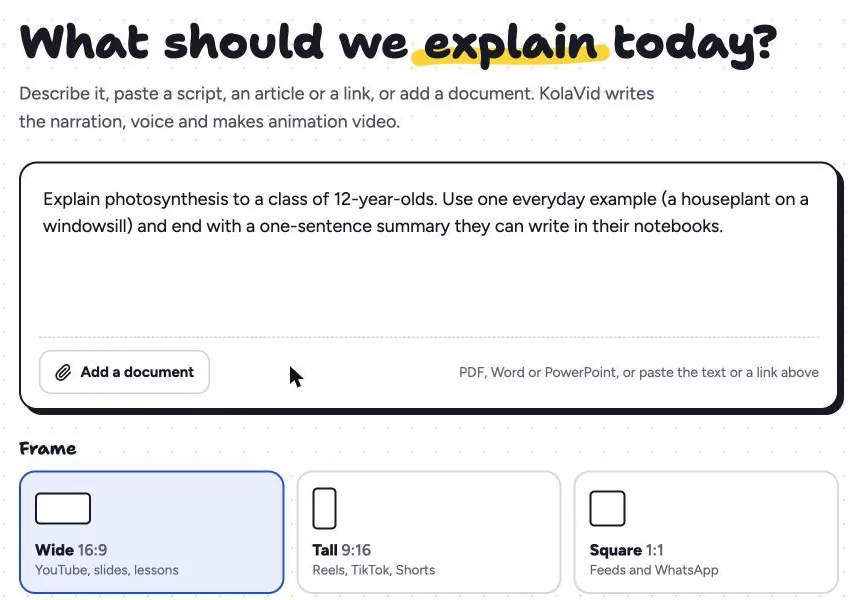
Choose Square 1:1 for feeds and WhatsApp, Tall 9:16 for Reels and Shorts, or Wide 16:9 for your website and presentations. Narration comes in many languages with a female or male voice, so you can make a version for each community you serve.
On cost: a free account includes one 2-minute video with no card needed, and free videos carry a small KolaVid mark. The Starter plan is $19.99 a month for 5,000 credits, about 83 minutes of whiteboard video. Many people scroll social media with the sound off, so download the MP4 with captions burned in (new whiteboard videos come with captions in the narration language), or upload the .srt file where the platform takes one. One honest limit: there is no editing timeline, so to change a figure you change the script and make the video again. The marketing page has sample videos, and our guide to low-cost AI video creation compares ways to make video on a small budget.
FAQ
How long should a nonprofit explainer video be?
Ninety seconds to two minutes for social media and donation pages. A programme explainer for partners can run to three or four minutes, but only if every part earns its place.
Can we use real beneficiaries' stories?
Yes, with informed consent: explain where it will be shown and for how long, make clear that saying no changes nothing about their support, and let them withdraw later. Change names when needed and say that you have.
Should an awareness video ask for money?
Not always. A pure awareness video can ask people to learn more, share, or come to an event. Pick one action. A second video can ask for donations.
How do we show impact without exaggerating?
Report what you did, with the year: sessions run, people reached, food grown. Avoid claims you cannot measure, such as "changed lives", unless you can show how.
Start with the question people ask you most
Think of the question you answer at every stall or open day, "So what do you actually do?", and make a 90-second video that answers it. For more on writing short videos that ask for one thing, see our guide to whiteboard videos for marketing, or see the documents page to turn your annual report into a video.