Real Estate Explainer Videos: Topics and Scripts
Real estate explainer video ideas for agents: the buying and renting process, mortgage basics in plain words and listing explainers, with a script to copy.
"What happens after my offer is accepted?" A real estate explainer video answers a question like that in about two minutes, in plain words, before the client has to call you. Buyers and renters ask agents the same handful of questions every week, so one short video per question saves a lot of repeat explaining and lets you spend meetings on each client's own situation.
Below: which topics work, how to explain buying, renting and mortgage basics without giving financial advice, listing explainers, and a full script to adapt.
What makes a good real estate explainer topic
The best topics share three traits: clients ask about them often, the answer is the same for most clients, and the answer is easier to follow as a sequence of pictures than as a page of text.
| Topic | Who it helps | Format notes |
|---|---|---|
| The steps of buying a home | First-time buyers | One overview, then one video per stage if needed |
| What happens after an offer is accepted | Buyers under contract | The most anxious stretch; a video calms it |
| How renting works, from application to move-in | Renters, landlords | Useful in two versions: for tenants and for owners |
| Mortgage words in plain language | First-time buyers | Definitions only, no recommendations |
| What closing costs are (in general) | Buyers | Explain the types of cost, not amounts |
| How selling works, from valuation to completion | Sellers | Good for listing presentations |
| A listing explainer | Buyers of one property | Explains something photos cannot: a shared driveway, a service charge, a heat pump |
A note on accuracy and advice
Real estate rules differ by country, state and city, and so do the words: "closing" in the US is "completion" in England. Write for your market, and have your broker or manager check the script once.
Two rules keep you on safe ground:
- Explain, do not advise. A video can say what a fixed rate is. It should not say which mortgage a viewer should choose. End anything about money with a line pointing viewers to a licensed mortgage adviser or lender.
- Describe the property, not the person. In the US, fair housing rules cover advertising, and phrases about who a home suits ("perfect for young families") can be a problem. Describe rooms, features and location instead. Other countries have their own equality rules; check yours.
Explaining the buying process
A buying overview works best as a path with five to seven stops. Keep each stop to one or two sentences: what happens, and what the buyer does.
- Budget and pre-approval. A lender looks at your income, debts and credit and says how much they might lend. This tells you your price range before you fall for a house.
- Search and viewings. You look at homes in that range with your agent.
- Offer. You make an offer; the seller accepts, rejects or comes back with a different price.
- Checks. An inspection or survey looks at the condition of the home. The lender values it too.
- Final mortgage approval and legal work. The lender confirms the loan; a lawyer, title company or conveyancer checks ownership and prepares the documents.
- Closing. You sign, the money moves, and the home becomes yours.
- Keys.
Explaining the renting process
Renting has fewer steps, but each one causes confusion. A simple order:
- Find a place and apply. You fill in an application for the home you want.
- Checks. The landlord or agent checks references, income and sometimes credit.
- Holding deposit or application fee, where these are allowed in your area.
- The lease. Read what you sign: the term, the rent, who fixes what, and how to give notice.
- Deposit and first rent. Explain where the deposit is held and what it covers.
- Move-in inspection. Walk through and record the condition, with photos. This protects you at the end.
- Move-out. Give notice, clean, do a final inspection, and get your deposit back minus any agreed deductions.
A landlord version, covering the owner's side of each step, works well for property managers.
Mortgage basics in plain words
Mortgage words scare first-time buyers. A short glossary video, one word a board, helps. Keep it to definitions:
- Deposit or down payment: the part of the price you pay yourself. The lender lends the rest.
- Principal: the amount you borrowed.
- Interest: what the lender charges you for borrowing it.
- Term: how many years you have to pay it back.
- Fixed rate: the interest rate stays the same for a set period.
- Variable rate: the rate can go up or down over time.
- Pre-approval: a lender's early view of how much they might lend you. It is not a final yes.
Leave out example rates and payments; they date quickly and can read like an offer. End with a line such as: "Every situation is different, so talk to a licensed mortgage adviser or lender about yours."

Listing explainers
A property tour shows what a home looks like. A listing explainer covers what photos cannot:
- How the shared driveway, garden or parking works, and who maintains it.
- What the monthly service charge or homeowners' association fee pays for, in general terms.
- How the heat pump, solar panels or well water system works day to day.
- What a leasehold or co-op arrangement means for a buyer.
- How the home sits in its area: the walk to the station, the school route, the shops, drawn as a simple map.
Keep listing explainers factual and check every claim against the paperwork.
Worked example: "Your offer was accepted. What happens now?"
This is the stretch where buyers worry most and call most. The script below follows a typical US-style purchase; adjust the words and steps to your market.
Viewer: a first-time buyer who has just had an offer accepted. Goal: they know the next steps, what they need to do, and that waiting is normal. Length: about two minutes.
Your offer was accepted. Congratulations. The house isn't yours yet, but you're on the path, and here's what happens next.
>
First, your deposit. You'll usually pay an earnest money deposit soon after the offer is accepted. It's usually held by a third party, not the seller, and it counts toward your purchase at closing.
>
Next, the inspection. A professional inspector checks the home's condition: the roof, the wiring, the plumbing. If they find a problem, you can ask the seller to fix it, lower the price, or, depending on your contract, walk away.
>
Then the appraisal. Your lender sends an appraiser to check the home is worth what you're paying. If it comes in lower, the loan may change, and your agent will talk you through the options.
>
While that happens, your lender is doing the full mortgage approval. They may ask you for more documents. Send them quickly. Slow paperwork is a common reason closings slip.
>
At the same time, a title company or attorney checks that the seller really owns the home and that nothing is owed on it.
>
A day or two before closing, you do a final walk-through to check the home is in the condition you agreed.
>
Then closing day. You sign the documents, the money moves, and you get the keys.
>
Your contract sets the exact deadlines for each step, and your agent will remind you of them. If anything is unclear, ask. That's what we're here for.
That is about 235 words. On screen, each paragraph is one board: a handshake and a house, a jar of coins held by a third figure, an inspector with a flashlight under a roof, a house on a scale, a lender's desk with a folder, a magnifying glass over a deed, a person walking through a door, a set of keys.
Where to use real estate explainer videos
- After the first enquiry: "Here's a two-minute video on how buying works; let's talk about your situation on Thursday."
- In your buyer and seller guides, alongside the PDF. Our guide to turning a PDF into a whiteboard video covers how to adapt one.
- On listing pages, for the listing explainers.
- On social media, in a vertical version, as useful posts rather than adverts. See whiteboard videos for marketing.
Making a real estate explainer in KolaVid
KolaVid turns a prompt, pasted script, document or web link into a narrated whiteboard video, with each drawing appearing as the narrator says it. Paste the offer-accepted script above, or type a prompt such as: "Explain the steps of renting an apartment to first-time renters, from application to move-out. Friendly, plain tone. No legal advice. End by inviting them to ask their agent." You can also attach your buyer's guide with Add a document. Our prompt-to-video guide has more on writing prompts that work.
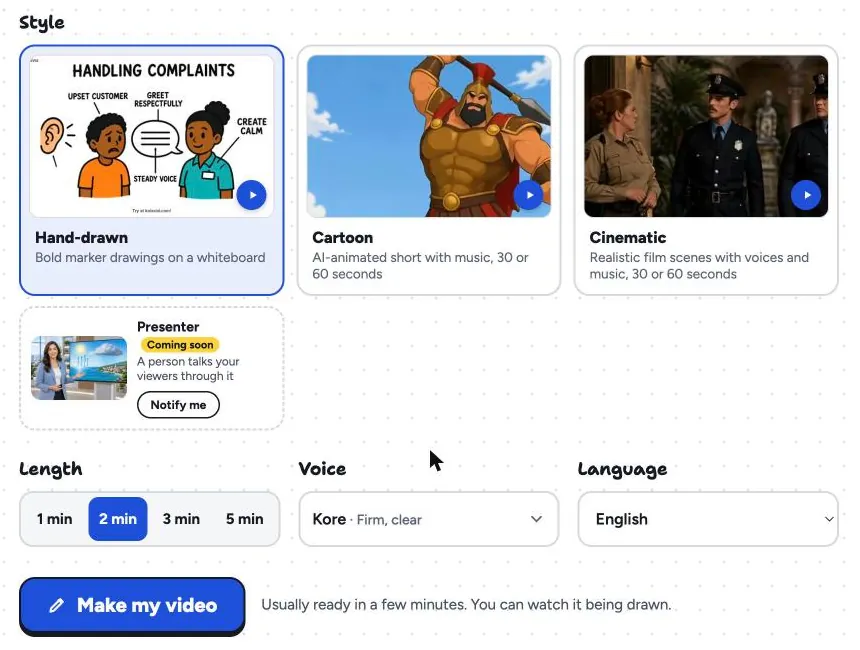
Pick the length (free videos run up to 2 minutes, paid plans up to 5), a female or male voice, and the narration language: the list includes Spanish and Portuguese, among many others, so the same script can serve clients in their own language. Choose Wide 16:9 for your website and email, or Tall 9:16 for Instagram and WhatsApp.
Honest notes: free videos carry a small KolaVid mark, and there is no presenter or avatar, so if clients like seeing you, film a short hello yourself. There is no editing timeline, so when a step changes, edit the script and make the video again. The marketing page shows sample videos.
FAQ
Can I talk about mortgages in a real estate video?
You can explain what mortgage terms mean and how the process works in general. Avoid recommending products, quoting rates or telling viewers what they can afford, and point them to a licensed adviser or lender for their own situation. Check your local rules on financial promotions if you are unsure.
How long should a real estate explainer video be?
One to two minutes for a single question or a listing explainer; up to three minutes for a full process overview. If it runs longer, split it by stage.
Should I make a video for every listing?
Not an explainer. Make one when a property has something buyers keep asking about, such as a shared driveway or an unusual heating system. Process videos can be reused for every client.
Can I make the same video in Spanish or another language?
Yes. Make a version in each language your clients use, and have a fluent speaker check it, since property words do not always translate directly.
Make the video you explain most
Look at your last ten client calls and find the question that came up most. Write the answer as six or seven short steps, read it aloud once, and turn it into your first explainer. A free KolaVid account includes enough credits for one 2-minute video, no card needed.