Research Paper Summary Video: How to Make One
How to turn a research paper into a short summary video: pick the one finding, use a five-part structure, keep claims honest. Worked example and script inside.
To make a research paper summary video, pick the single finding you want people to remember, then tell it in five parts: the question, the method in one line, the result, why it matters, and the limits. Keep it to 2 or 3 minutes, which is roughly 300 to 400 spoken words, and never say more than the paper shows. Everything else in the paper stays in the paper, one click away.
That is harder than it sounds: a paper is written to be complete, and a video has to be selective. This guide is for researchers summarising their own work and students summarising someone else's, with a worked example from a made-up study.
Who a paper summary video is for
The audience changes the words you use, so decide it first.
- Researchers in your field (a conference, a lab website, a journal that takes video abstracts): keep the terms they all know.
- Researchers in other fields (a grant panel, a cross-department seminar): explain your field's terms once.
- Students (a journal club, a reading list): explain the method a little more; how the study was done is part of the lesson.
- The public (social media, a patient group): no jargon, one everyday example, extra care with the limits.
If unsure, write for an interested non-specialist.
Step 1: Find the one finding
Most papers report several results. A short video can carry one. Choose the main one, usually the primary outcome named in the abstract, and write it as a single sentence in this shape:
In [who or what], [doing what] led to / was linked with [what change], measured by [how].
For a hypothetical walking trial, it might read: "In adults with mild hypertension, a daily walking programme was linked with lower blood pressure after 12 weeks, measured by home readings." If you cannot write this sentence, you are not ready to script the video. Go back to the abstract and the results section until you can.
Everything else, including secondary outcomes, subgroup analyses and sensitivity checks, either supports this sentence in one line or stays out.
Step 2: Use the five-part structure
This shape works for almost any empirical paper. The timings are for a 2-minute video of around 280 words.
| Part | What it says | Time | Words |
|---|---|---|---|
| 1. The question | What we did not know, and why someone would care | 20 s | about 45 |
| 2. The method in one line | Who or what was studied, what was done, what was measured | 20 s | about 45 |
| 3. The result | The one finding, with its size in plain terms | 30 s | about 70 |
| 4. Why it matters | What it changes for practice, policy or the next study | 25 s | about 60 |
| 5. The limits | What the study cannot tell us, and what would settle it | 25 s | about 60 |
Note that the method gets one line, not a minute; viewers who want detail will read the paper. And the limits get as much time as why it matters, because they are the easiest part to leave out.
Writing each part
The question. Start with the gap, in the viewer's terms, not with the field's history.
The method. One sentence: who, how many, what was done, for how long, what was measured. Name the design (trial, survey, cohort, model, interviews), because it tells viewers how much weight the result can take.
The result. Say the size of the effect, not just its direction. "Lower" is less useful than "about 5 points lower on average". If the paper reports an absolute and a relative figure, give the absolute one, or both. A drop from 2 in 100 to 1 in 100 is "half as many", but it is also "one fewer person in a hundred".
Why it matters. Say who should do what differently, only as far as the result supports. Often the honest version is "worth testing in a larger group", not "this should change practice".
The limits. Pick the two or three that matter most to the conclusion: the sample, the length of follow-up, the setting, how the outcome was measured, whether it shows cause or only association. Then say what study would answer the question properly.
Step 3: Say only what the paper shows
Short formats push towards bigger claims. A video that overstates a result spreads further than the paper does, and it is your name on it. Check every sentence of the script against these swaps.
| Avoid | Say instead | Why |
|---|---|---|
| "proves" | "found", "showed in this group" | One study rarely proves anything |
| "causes" (for observational data) | "was linked with", "went together with" | Association is not cause |
| "cures", "prevents" | "reduced", "lowered the rate of" | Say the size of the change |
| "people" (for animal or cell studies) | "mice", "cells in the lab" | Results often change between models and humans |
| "will" | "may", "could", "in this study" | The result is from one setting |
| "a breakthrough" | describe what is new, plainly | Let viewers judge |
Three more checks before you record:
- Does the result in the script match the number in the paper's results section? Not the press release, not the abstract's rounded version.
- Would the authors agree with "why it matters"? If it goes beyond their discussion section, cut it back.
- Is the biggest limitation in the video? If a reviewer would raise it first, the viewer should hear it.
Worked example: a made-up paper
The paper below does not exist. It is invented for this guide so you can see the method from start to finish without anyone's real work being simplified.
Fictional abstract. *Post-lunch walking and afternoon attention in office workers: a three-week randomised trial.* We randomly assigned 120 volunteer office workers at one company to a 10-minute walk after lunch or to their usual break, for three weeks. The primary outcome was the score on a computer-based attention task at 3 p.m. on the final day. The walking group scored higher on average (difference 4 points on a 100-point scale). No difference was found in self-reported tiredness. Participants were volunteers from a single workplace and the task was done in a quiet room, which may not reflect normal working conditions.
The one finding: "In office workers, a 10-minute walk after lunch was linked with slightly better scores on an afternoon attention test after three weeks, measured by a computer task."
The script (about 220 words, just under 2 minutes):
- The question. "That mid-afternoon slump is familiar to anyone with a desk job. Plenty of advice says a short walk after lunch helps you focus. But does it make a difference you can actually measure?"
- The method. "Researchers asked 120 office workers at one company to take part for three weeks. Half were chosen at random to walk for 10 minutes after lunch. The other half took their usual break. On the last day, everyone did an attention test at 3 p.m."
- The result. "The walkers scored a little higher: about 4 points more, on a test scored out of 100. That is a small difference, but it was there on average across the group. Interestingly, the walkers did not say they felt any less tired."
- Why it matters. "A 10-minute walk costs nothing, so even a small benefit could be worth having. It also gives a clear idea to test properly in a bigger study."
- The limits. "There are real limits. Everyone was a volunteer, from one workplace, so they may have been keener than most. The study lasted three weeks. And the test was done in a quiet room, not at a busy desk. A larger trial, across different workplaces and over months, would tell us whether the effect holds."
- Close. "So: a short walk after lunch was linked with slightly sharper attention in this study. Promising, small, and worth a bigger test."
Notice what the script does not say. Not "walking boosts productivity" (productivity was never measured), not "beat the afternoon slump" (tiredness did not change), and not "proven" (one small trial). The overstated version would make a catchier video. It would also be wrong.
Step 4: Plan the pictures
A paper's figures are made for readers who can study them; a viewer gets a few seconds per picture. Plan one simple picture per part. For the example: a person at a desk in the afternoon, two groups side by side (one walking, one sitting), two bars drawn large, and a single building for "one workplace". Redraw the key result rather than pasting the paper's full figure. If you do want to reuse an original figure, check the paper's licence and the publisher's reuse policy first, and credit it on screen or in the description.
Step 5: Check it with someone who knows the paper
Show the script to a co-author, or for someone else's paper, a supervisor or colleague in the field, and ask one question: "Is there anything here the paper does not support?" Then put the full reference and a link in the video description, every time.
Making the summary video in KolaVid
If you would rather not record or animate it yourself, KolaVid makes a narrated whiteboard video from a PDF upload, a Word or text file, pasted text or a link, with each drawing appearing as the narrator says it, one idea on each board. Upload the paper's PDF with Add a document and write a brief that does the selecting:
"Summarise this paper in 2 minutes for interested non-specialists. Focus only on the primary outcome. Structure: the question, the method in one sentence, the result with its size, why it matters, and the main limits. Do not say the study proves anything. End by naming the biggest limitation."
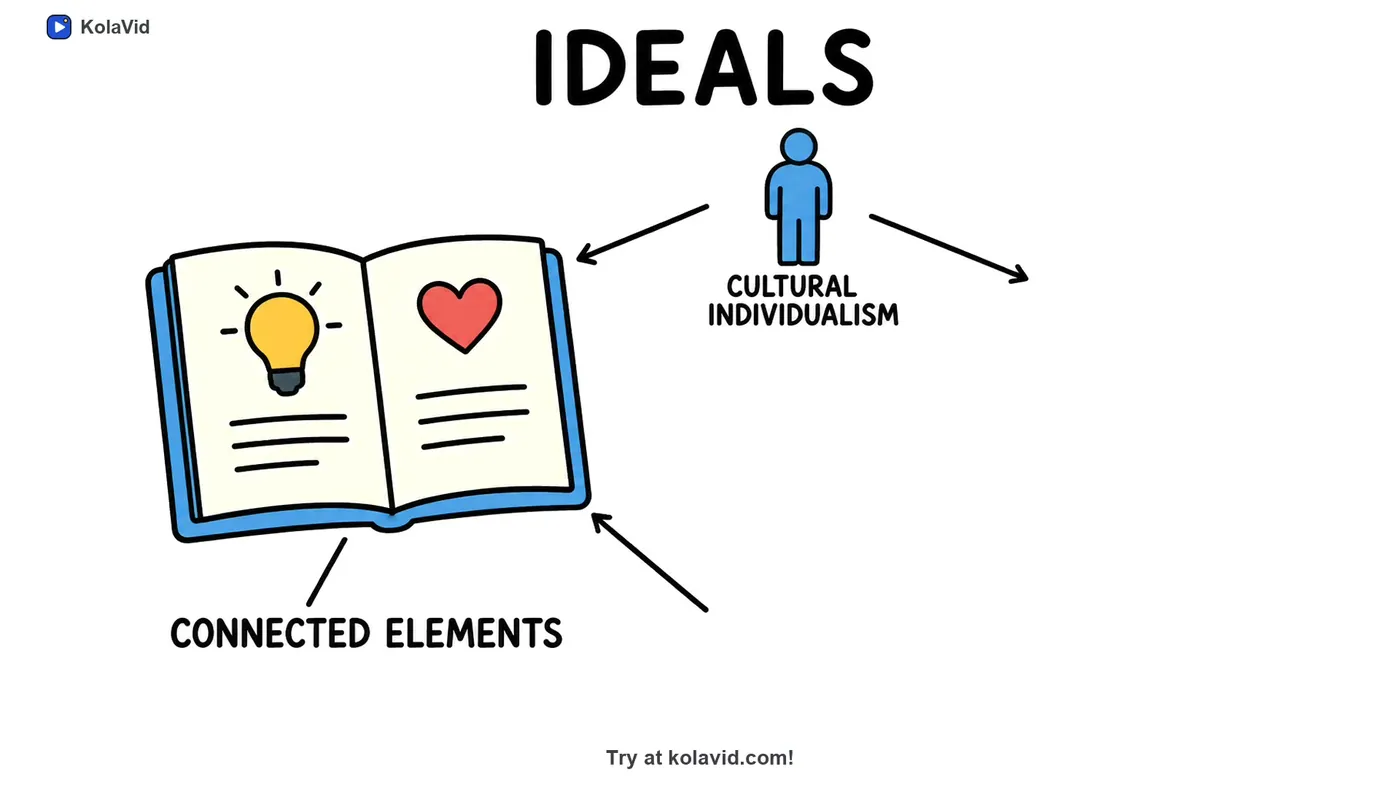
In this frame from KolaVid's sample video "A Research Paper, Summarised", one board takes a single idea from the paper and draws it plainly.
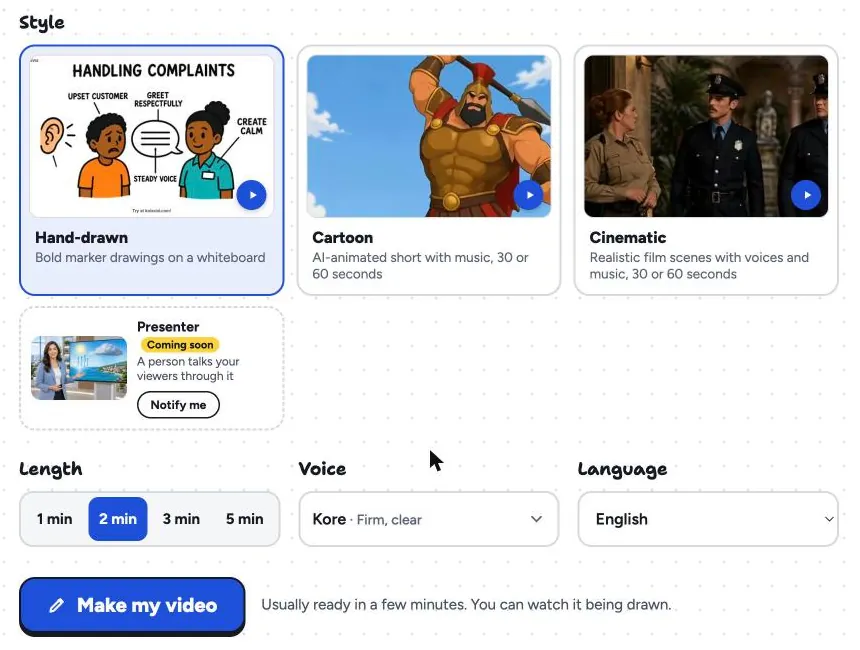
Choose the length (1, 2, 3 or 5 minutes; free videos up to 2, paid plans up to 5), the voice, the narration language and the frame: Wide 16:9 for a lab website, Tall 9:16 for phones. It is usually ready in a minute or two.
Whatever tool you use, check every claim in the narration against the paper before sharing, using Step 3. If a sentence goes further than the results, change the brief or paste your own script and make it again; there is no editing timeline inside the video. The documents page shows how uploads are handled, and our guide to turning notes into an explainer video helps if you are working from reading notes instead.
FAQ
How long should a research paper summary video be?
Two to three minutes for one paper, which is 300 to 400 spoken words. A conference or journal may set its own limit, so check their guidelines first. If you need longer, the video is probably covering more than one finding; see our comparison of short and long explainer videos for how to decide.
Can I make a video summarising someone else's paper?
Yes, summarising published research is normal in teaching and journal clubs. Credit the authors, link to the paper, describe the findings accurately, and check the licence before reusing figures. For anything public, it is courteous to tell the authors.
Should a summary video include statistics like p-values?
For specialists, a confidence interval or effect size in one line can help. For everyone else, give the size of the effect in plain terms ("about 4 points higher out of 100") and say how many people were studied. That tells most viewers more than a p-value would.
Can students use this to present a paper in a seminar?
Yes. The five-part structure makes a good 3-minute opening to a journal club or seminar presentation. Our students page shows other ways students use short explainer videos.
Start with the one sentence
Take the paper you know best, write the one-finding sentence and the two most important limits, and you have the core of a two-minute video. The rest is putting those few lines in order and saying them plainly.