How to Explain Complex Topics Simply: 6 Techniques
How to explain complex topics simply: one idea at a time, a concrete example first, an analogy, plain words and a check. Worked example on compound interest.
To explain a complex topic simply, find the one idea that matters most and say it in a single plain sentence. Start with a concrete example before the general rule, borrow an analogy from your listener's life, swap jargon for everyday words, give one idea at a time in order, and finish by asking the listener to explain it back to you. Simple does not mean leaving out what is true; it means leaving out what this listener does not need yet.
Below are the six techniques, each with a short example, then a worked example that takes compound interest from a textbook definition to an explanation a teenager could follow. A checklist you can copy is at the end.
Why experts explain things badly
The better you know a topic, the harder it is to remember what it was like not to know it. Psychologists call this the curse of knowledge. You skip steps that feel obvious, use words you no longer notice are technical, and start from the general rule because that is how you now think about it.
Your listener needs the opposite: the skipped steps, familiar words, and a specific case before the rule. Each technique below puts you back in their position.
Technique 1: Find the one-sentence core
Before you explain anything, finish this sentence: "If they remember only one thing, it should be..."
- Photosynthesis: "Plants use light to turn air and water into their own food."
- Inflation: "When prices rise across the board, the same money buys less."
- Vaccines: "A vaccine shows your immune system a harmless version of a germ, so it is ready if the real one arrives."
Everything else should support that sentence or wait. If you cannot write it, you are not ready to explain the topic yet, which is better discovered before you start.
Technique 2: Give a concrete example first, then the rule
Most textbooks give the rule and then an example. Most people understand the other way round. A specific case gives the mind something to hold; the rule then names what they have just seen.
Rule first: "Friction is a force that opposes motion between two surfaces in contact."
Example first: "Rub your hands together fast. Feel them warm up, and feel how they resist sliding? That push-back is friction. It happens whenever two surfaces rub."
The second lands better because the listener feels the idea before hearing the word for it.
Technique 3: Use an analogy, and say where it breaks
An analogy maps something unfamiliar onto something the listener already understands. Good ones come from your listener's daily life, not yours.
- Electric current as water flowing through a pipe: the voltage is the pressure, the wire is the pipe.
- The immune system's memory as a "wanted" poster: once it has seen the face, it recognises it next time.
Every analogy breaks somewhere, and a listener who stretches it too far learns something false. Say where it stops working: "Unlike water, electricity does not leak out of a cut wire onto the floor." One sentence is enough.
Technique 4: Cut the jargon, or define it once
Go through your explanation and underline every word a 14-year-old might not know. For each one, either replace it or define it.
| Jargon | Plain swap |
|---|---|
| utilise | use |
| mitigate | reduce |
| principal (in finance) | the money you start with |
| asymptomatic | with no symptoms |
If the listener will meet a term again, keep it but introduce it after the idea ("The money you start with is called the principal"), then use that one word consistently. Switching between "principal", "deposit" and "starting balance" sounds like three different things.
Technique 5: One idea at a time, in order
Topics usually feel complex because several ideas arrive at once. Break yours into steps where each needs only the ones before it.
A quick test: write each idea on its own line. If line 4 uses something first explained on line 6, reorder. Merge lines that repeat; cut lines the core does not need.
A one-line summary before the next idea ("So, money grows. Now here is the surprising part...") gives the listener time to file it.
Technique 6: Check understanding properly
"Does that make sense?" almost always gets a yes, because saying no feels awkward. Ask questions that need the idea to answer:
- "Can you explain it back to me in your own words?"
- "What do you think would happen if...?" (a new case you did not cover)
- "Which of these two examples is an example of it?"
A wrong explain-back shows you exactly which step to repeat.
Worked example: compound interest, from jargon to plain
Here is a typical definition, the kind found in a textbook or bank document.
Before. "Compound interest is interest calculated on the initial principal and on the accumulated interest of previous periods. For a principal P at an annual rate r, compounded n times per year for t years, the future value is A = P(1 + r/n)^(nt). Over long horizons, compounding produces exponential rather than linear growth relative to simple interest."
Accurate, and almost useless to a beginner. Here are the techniques applied one by one.
Technique 1, the core. "With compound interest, your interest starts earning interest too, so your money grows faster and faster."
Technique 2, an example first. Put 1,000 dollars in a savings account paying 5% a year. After the first year you earn 50 dollars, so you have 1,050. In the second year you earn 5% of 1,050, which is 52.50, so you have 1,102.50. The extra 2.50 is interest earned on last year's interest.
Technique 3, an analogy. A snowball rolling downhill. It picks up snow, gets bigger, and so picks up more snow on the next turn. Where it breaks: a real snowball eventually stops at the bottom of the hill; compound interest keeps going as long as the money stays in and the rate holds.
Technique 4, the jargon. "Principal" becomes "the money you start with". "Accumulated interest of previous periods" becomes "the interest you have already earned". "Exponential rather than linear" becomes "faster and faster, rather than the same amount each year".
Technique 5, one idea at a time. The order: you earn interest on your money; that interest is added to your money; next year you earn interest on the bigger amount; repeat; over many years the difference becomes large.

The comparison that makes it stick. Simple interest pays 50 dollars every year, forever, on the original 1,000. Compound interest pays on the growing total.
| After | Simple interest (5%) | Compound interest (5%) |
|---|---|---|
| 1 year | 1,050 | 1,050 |
| 10 years | 1,500 | 1,628.89 |
| 20 years | 2,000 | 2,653.30 |
| 30 years | 2,500 | 4,321.94 |
The columns barely differ for years, then pull away. That gap is the whole lesson.
After. "Imagine you put 1,000 dollars in a savings account that pays 5% a year. After one year you've earned 50 dollars, so you have 1,050. Next year, you earn 5% on the whole 1,050, not just the original 1,000. So you earn a little more: 52.50. That's the key idea. Your interest starts earning its own interest. It's like a snowball rolling downhill: the bigger it gets, the more snow it picks up each turn. At first the difference is tiny. But leave the money for 30 years and you'd have about 4,300 dollars, compared with 2,500 if you only ever earned interest on the original amount. That's compound interest: interest on your interest, growing faster the longer you wait. It works against you too, by the way. On a debt, the interest you owe can start costing interest of its own."
Technique 6, the check. Ask: "If you left the money in for 40 years instead of 30, would those extra ten years add more or less than the ten years between year 20 and year 30 did?" Someone who answers "more" has understood compounding. Someone who says "the same" is still thinking in simple interest, and you know which step to go back to.
The plain version dropped the formula and the word "exponential". Neither was wrong, and a finance student will need both later; a first explanation only needs the idea. For more topics like this, our piece on explaining finance concepts with whiteboard videos has further examples.
A checklist you can copy
``` EXPLAINING A COMPLEX TOPIC: CHECKLIST
[ ] One-sentence core: "If they remember one thing, it is..." [ ] Who is listening, and what do they already know? [ ] A concrete example comes BEFORE the general rule [ ] One analogy from the listener's life, and where it breaks [ ] Every technical word replaced, or defined once and used consistently [ ] Ideas in order: nothing used before it is explained [ ] One idea per step, with a short summary before the next [ ] Anything not needed for the core is cut (or saved for later) [ ] A check question that needs the idea to answer (not "does that make sense?") ```
Turning the explanation into a video
A plain explanation is most of the way to a short video. Each step from Technique 5 becomes one scene with one picture: the 1,000 dollars, the first 50 dollars of interest, the snowball, the two columns pulling apart. One picture per idea, shown as it is said, follows the same rule you have just applied. If the topic is a sequence of steps rather than a concept, our guide to explaining a process in a video covers mapping and signposting.
KolaVid makes this kind of video from a typed prompt or pasted script, with each drawing appearing as the narrator says it, one idea on each board. Paste the "After" text as your script, or write a brief such as:
"Explain compound interest to 15-year-olds in 2 minutes. Start with one example: 1,000 dollars in a savings account at 5% a year. Use the snowball analogy and say where it breaks. Compare simple and compound interest after 30 years. End with a question they can answer to check they understood."
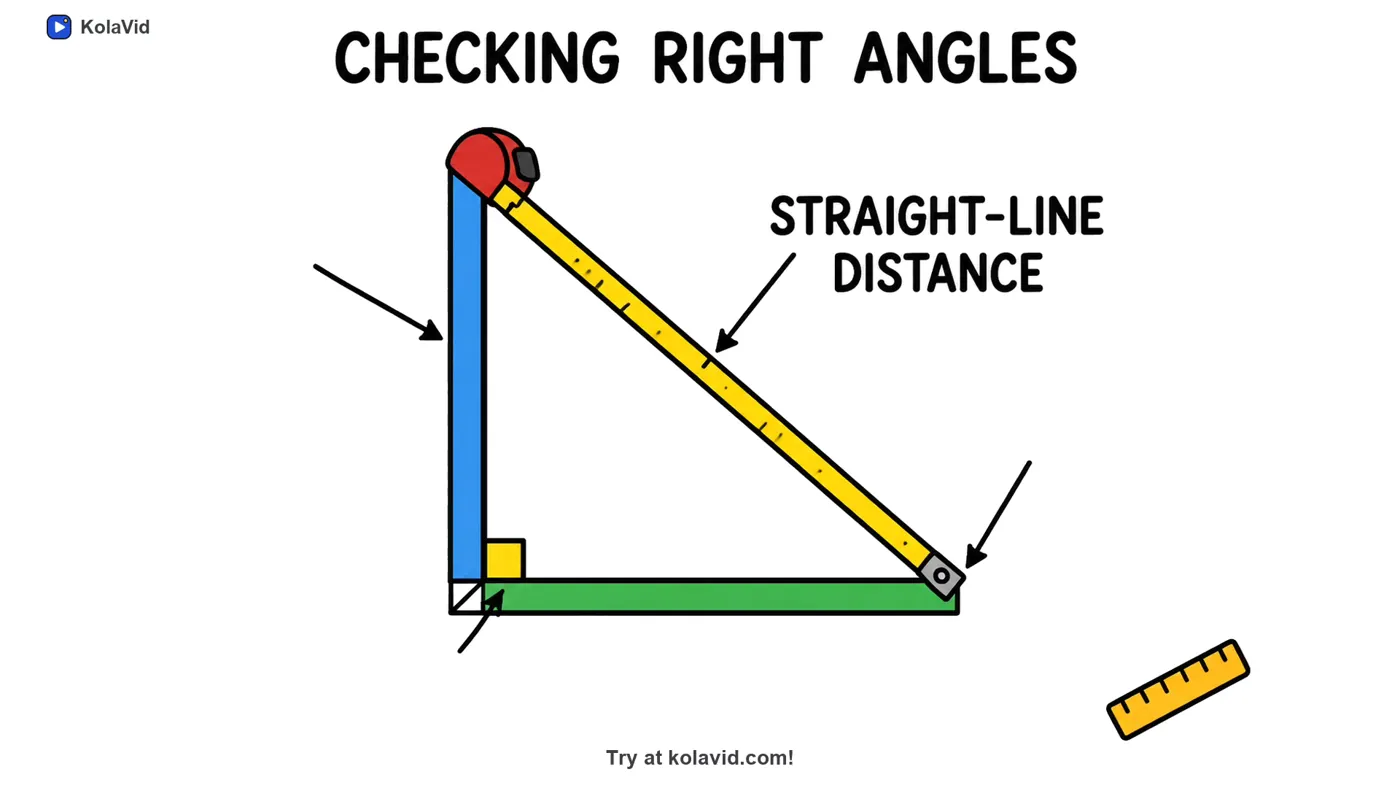
In this frame from a KolaVid sample video, an abstract idea, the Pythagorean theorem, is shown through a concrete object: a tape measure checking a right angle.
Choose the length (1, 2, 3 or 5 minutes), voice and narration language; it is usually ready in a minute or two. A free account covers one video of up to 2 minutes. Our guide to writing prompts for whiteboard videos goes further on briefing the tool, and the teachers page has sample lessons.
FAQ
What is the Feynman technique?
It is a study method named after the physicist Richard Feynman: explain a topic in simple words as if to a beginner, notice where you get stuck or reach for jargon, go back to the source to fill that gap, and simplify again. It works because explaining exposes what you do not yet understand. Techniques 1, 4 and 6 above are the same idea used on someone else.
How do I know if I am oversimplifying?
Ask whether anything you said is false, not just incomplete. "Your interest earns interest" is incomplete but true. "Compound interest always doubles your money" is false. A good simple explanation can be built on later without being taken back. If an expert would have to tell your listener "forget what you were told", you went too far.
How do I explain a complex topic to a mixed audience?
Pitch the main explanation at the newest person in the room, and add depth in short asides: "For those who like the maths, here is the formula." Experts rarely mind clear basics; beginners always mind being lost.
Try it on the topic you explain most
Pick the question you answer most often at work or in class. Write the one-sentence core, find one concrete example and one analogy, and try the explanation on someone new to it this week. Their explain-back will tell you which step to fix.