Math Lesson Video: Teach a Method With One Example
How to explain math in a short lesson video: one worked example with reasons, the common mistake, a practice question. Three ready prompts, answers checked.
The clearest way to explain a math method in a short video is to solve one problem completely, saying why each step happens, then show the mistake students usually make and finish with a practice question for them to try. One example done well teaches more than three done quickly.
Below is the shape to follow, how to pick numbers that show the method instead of hiding it, and three ready prompts with every answer checked.
Why one worked example beats a list of rules
Students who watch a math video usually want to know: "What do I actually do?" A list of rules answers that in general. A worked example answers it for a real problem, and students can copy the pattern onto the next one.
One example also leaves room for the part that matters most: the reason behind each step. "Subtract 7 from both sides" is a rule. "Subtract 7 from both sides, because we want x on its own and the scale stays balanced only if both sides change the same way" is an explanation. In a short video, you only have time for reasons if you only have one example.
The five-part shape of a math video for students
- The problem, stated plainly. Show it and read it aloud. If it comes from a context (a ladder, a pizza, a phone bill), give the context in one sentence.
- The steps, one at a time, with the reason. One operation per step. Say what you do, then why.
- The check. Put the answer back into the problem, or estimate to see if it makes sense. This teaches a habit, not just a method.
- The common mistake. Show the wrong method students really use, and why it gives a wrong answer.
- A practice question. One problem of the same type, with the answer given at the very end so students can pause and try first.
For one method, this fits into two to three minutes of narration. Longer usually means a second example has crept in.
How to explain math out loud
Math written on paper and math spoken aloud are different things. A few habits make the narration easier to follow:
- Say every symbol the way you want students to say it. "Four x minus seven equals twenty-one", not "four x, minus, seven..." with pauses that sound like separate numbers.
- Name the operation before you do it. "Now we add seven to both sides" lets students predict what will appear.
- Use the same word every time. If you say "denominator" once, do not switch to "bottom number" halfway through. If your class says "bottom number", use that throughout.
- Never say "obviously" or "simply". The student who is lost hears that they should not be.
Choose numbers that show the method
The numbers in your example can quietly make the method clearer or confusing. Some rules of thumb:
- Avoid numbers that hide the steps. In Pythagoras, a right triangle with sides 3, 4 and 5 is fine, but if the legs are equal the student cannot tell which side is which. Use different-looking numbers.
- Avoid coincidences. 2 + 2 and 2 × 2 are both 4. An example where two wrong methods give the right answer teaches nothing.
- Make the answer a whole number for the first example. Decimals and negatives can come in the next video.
- Make the common mistake visible. In fractions, 1/3 + 1/4 is a good example because the wrong answer, 2/7, is smaller than 1/3 on its own, which students can see is impossible.
Three ready prompts (answers double-checked)
Each prompt below works as a script brief for an AI video tool, or as notes for recording your own explanation. Every number has been checked by hand.
Fractions: adding with different denominators (ages 10 to 11)
The math: 1/3 + 1/4. The smallest common denominator is 12. 1/3 = 4/12 and 1/4 = 3/12, so the sum is 7/12.
Check: 1/3 is about 0.33 and 1/4 is 0.25, together about 0.58. And 7/12 is about 0.58.
Common mistake: adding tops and bottoms to get 2/7. That is about 0.29, less than 1/3 alone, so it cannot be right.
Practice question: 2/5 + 1/3. Answer: 6/15 + 5/15 = 11/15.
Explain to 10 and 11 year olds how to add fractions with different denominators. Use one example: one third plus one quarter. Show both fractions as slices of the same size pizza, then change them to twelfths: one third is four twelfths, one quarter is three twelfths, so the answer is seven twelfths. Check it by comparing the sizes. Show the common mistake of adding the tops and the bottoms to get two sevenths, and why that answer is too small. End with a practice question, two fifths plus one third, and give the answer, eleven fifteenths, at the very end. 2 minutes.
Solving a linear equation (ages 12 to 13)
The math: 4x − 7 = 21. Add 7 to both sides: 4x = 28. Divide both sides by 4: x = 7.
Check: 4 × 7 − 7 = 28 − 7 = 21. Correct.
Common mistake: subtracting 7 instead of adding it (4x = 14), or dividing only one side by 4.
Practice question: 5x + 3 = 43. Answer: 5x = 40, so x = 8.
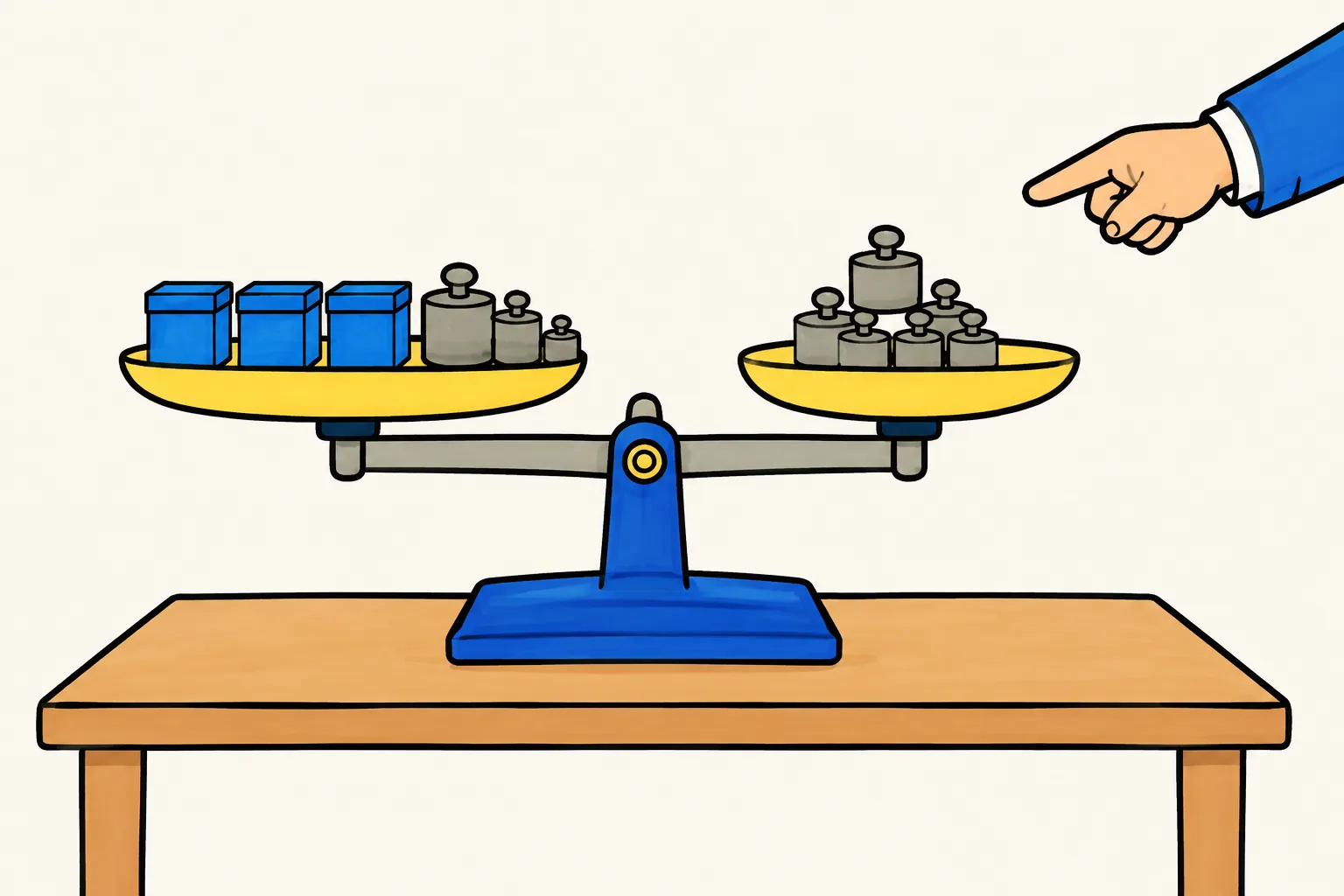
Explain to 12 and 13 year olds how to solve a two-step equation, using a balance scale as the picture. Use one example: four x minus seven equals twenty-one. Step one, add seven to both sides, because we want x on its own and the scale stays balanced only if both sides change the same way: four x equals twenty-eight. Step two, divide both sides by four: x equals seven. Check by putting seven back in: four times seven is twenty-eight, minus seven is twenty-one. Show the common mistake of subtracting seven instead of adding it. End with a practice question, five x plus three equals forty-three, and give the answer, x equals eight, at the very end. 2 minutes.
Pythagoras' theorem (ages 13 to 14)
The math: in a right-angled triangle, the square of the longest side (the hypotenuse) equals the sum of the squares of the other two sides. With legs 5 and 12: 5² + 12² = 25 + 144 = 169, and √169 = 13. The hypotenuse is 13.
Check: the hypotenuse must be the longest side. 13 is longer than 12, and shorter than 5 + 12 = 17, as any side of a triangle must be.
Common mistakes: adding the sides without squaring (5 + 12 = 17), forgetting the square root (answering 169), or using the theorem on a triangle with no right angle.
Practice question: legs 8 and 15. Answer: 64 + 225 = 289, √289 = 17.
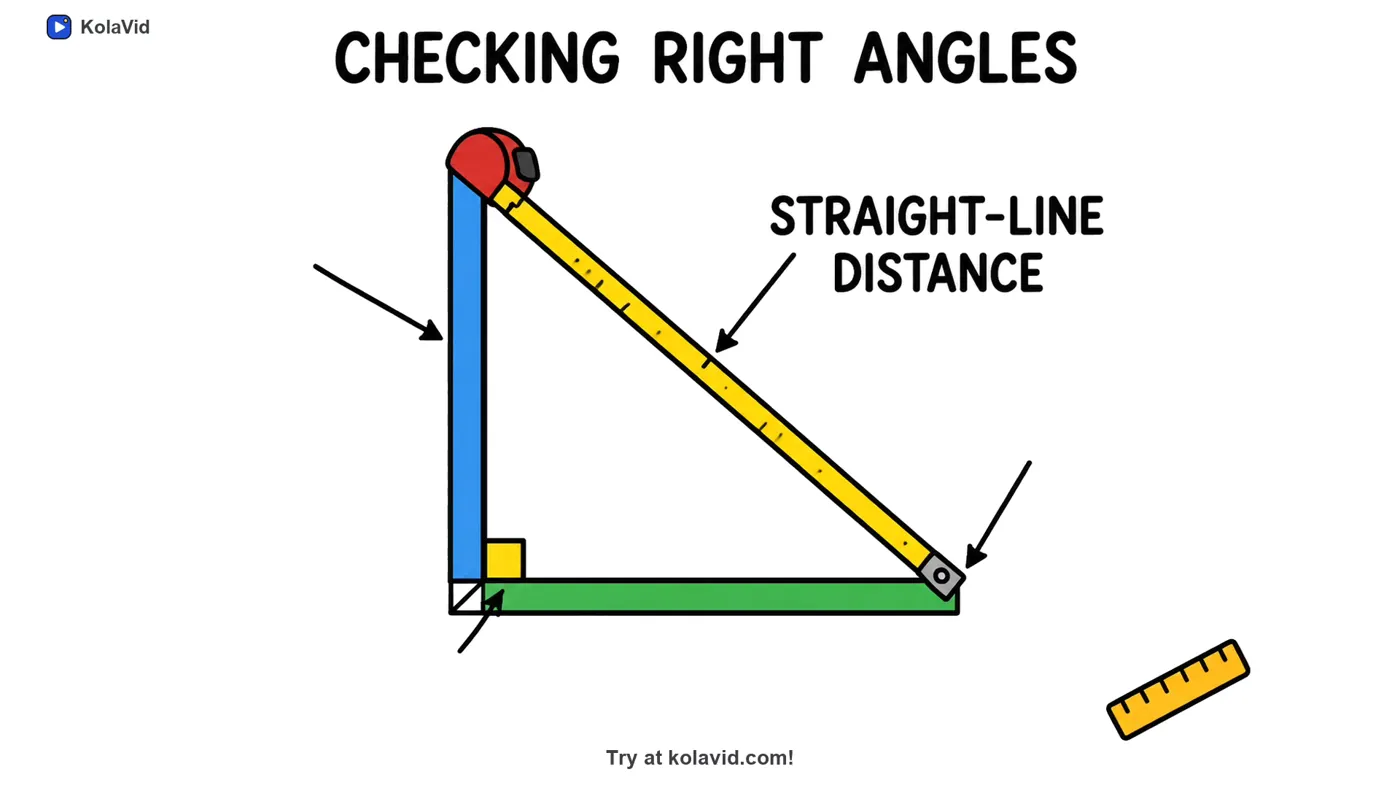
Explain Pythagoras' theorem to 13 and 14 year olds. Start with a builder checking that a corner is a right angle: measure 3 metres along one wall and 4 metres along the other, and if the diagonal is 5 metres the corner is square, because 9 plus 16 is 25. Then solve one example: a right-angled triangle with shorter sides 5 and 12. Square them, 25 and 144, add them to get 169, and take the square root to get 13. Check that 13 is the longest side. Show the common mistakes: adding 5 and 12 without squaring, and forgetting the square root. End with a practice question with shorter sides 8 and 15, and give the answer, 17, at the very end. 3 minutes.
The three prompts share a pattern: the age, one example with every step and reason written out, the check, the mistake, and the practice question with its answer held to the end. Writing the math into the prompt yourself is the safest way to make sure the video says exactly what you would say. Our guide to prompt writing for whiteboard videos explains why detailed prompts work better than short ones.
Check every number before students see it
A wrong number in a math video is worse than no video. Students copy what they see, and a confident narrator makes an error look right. Before you share any math video, whether you recorded it or generated it:
- Pause on every line of working and redo it yourself.
- Check the practice answer separately; it is the number students will compare their own work against.
- Listen to the words as well as the symbols. "Four x" heard as "four times" or "for x" can confuse younger students.
- Watch the order. Steps must appear in the order they are spoken, or the reasoning falls apart.
If anything is off, remake it. Redoing a two-minute video is quicker than unteaching a wrong method.
Making a math lesson video with KolaVid
KolaVid turns a prompt like the ones above into a narrated whiteboard video, where each drawing appears as the narrator says it, one idea on each board. Paste one of the three prompts, choose the frame (Wide 16:9 for the classroom screen, Tall 9:16 or Square 1:1 for phones) and a length of 1, 2, 3 or 5 minutes. Free videos run up to 2 minutes, and a video is usually ready in a minute or two.
Here is a frame from a sample Pythagoras video, on checking right angles, the same idea as the builder's check in the third prompt: two shorter sides meeting at a right angle, and a tape measure for the straight-line distance across.
Then watch it through with the checklist above. There is no editing timeline, so if a step needs changing you edit the prompt and make the video again. When it is right, download the MP4 or share a link. The teachers page has more sample lessons. If you plan to use these videos before class rather than in it, our article on flipped classroom videos covers how to check students watched.
FAQ
How long should a math lesson video be?
Two to three minutes for one method with one worked example. If students need a second example, make a second video, so each one stays easy to find and rewatch.
Should I show more than one example?
In the video, usually not. Show one example fully, then give the practice question. Extra examples belong in class or on the worksheet, where you can see whether students are following.
How do I explain math to students who are behind?
Start from a picture they already know, like pizza slices for fractions or a balance scale for equations, and make each step a single operation with its reason. Short videos they can pause and rewatch help more than one long explanation.
Start with the method students get wrong most
Think of the last test you marked and the method that cost the most marks. Write the example, the mistake and the practice question, and make a two-minute video around it. A free KolaVid account includes one 2-minute video with no card needed, enough to try it on one method this week. For more on planning lesson videos in general, see how to make an educational video.