Leadership Training Videos for New Managers
Leadership training videos for new managers: which topics to cover, a scenario-based script shape, a worked lateness conversation, and how HR can use them well.
The most useful leadership training videos for new managers are short scenarios built around specific moments: giving feedback, running a one-to-one, delegating a task, and having a difficult conversation. Each video shows one situation, the approach in a few steps, the actual words a manager could say, and the mistake most people make. They work best as preparation and a shared reference, alongside practice and coaching, not as a replacement for them.
This guide is for HR and L&D teams, and for anyone who has to help first-time managers find their feet. It covers which topics to make first, a scenario-based script shape, a worked example on raising repeated lateness, and how to use the videos so they change behaviour rather than sit in a library.
What video can and cannot do for leadership skills
Leadership is learned by doing, so it is fair to ask what a video adds. Three things, mainly.
A consistent model. Every new manager in the organisation hears the same approach to a one-to-one, in the same words. That makes later coaching easier, because everyone shares a vocabulary.
Help at the moment of need. A manager about to have their first difficult conversation can rewatch a three-minute video ten minutes beforehand. Nobody rereads a workshop handout that way.
Something to discuss. A short scenario gives a group of new managers a common case to talk about, without anyone having to share a real situation from their own team.
What video cannot do is let someone practise. Hearing how to give feedback is not the same as giving it to a person who reacts. Pair each video with a role-play, a conversation with their own manager, or a real one-to-one they reflect on afterwards.
Topics new managers need first
Organise leadership training around moments, not competencies. "Communication" is not a video. "Telling someone their work needs to change" is.
| Moment | What the video teaches | When they need it |
|---|---|---|
| Your first one-to-one with each person | A simple agenda: their priorities, what gets in their way, what they need from you | First two weeks |
| Giving feedback on good work | Name the specific thing they did and why it mattered | Week one, and often |
| Giving feedback that asks for a change | Situation, behaviour, impact, then agree the next step | First time it happens |
| Delegating a task | Explain the outcome, the deadline, the limits of their authority, and when you will check in | First month |
| Saying no or reprioritising | How to explain a trade-off to your team and to your own manager | First month |
| A difficult conversation | Prepare, open plainly, listen, agree a next step, follow up | Before the first one |
| Managing people who used to be your peers | Changing the relationship without pretending nothing changed | First week, for internal promotions |
| Conflict between two team members | Listen to each separately, then agree how they will work together | When it happens |
Many HR training videos sit beside these: how your organisation runs absence and return-to-work conversations, how a performance concern is raised formally, how to handle a complaint from a team member. Those videos should explain your own policy and process, reviewed by HR, and point managers to HR for anything unusual. They are not a substitute for advice on a specific case.
If you have a longer new-manager course you want to break up, our guide to microlearning videos shows how to split one into short, single-moment videos.

A scenario-based script shape
Leadership topics land better as a story than as a list of principles. This five-part shape works for almost any moment on the list.
- The situation. A named, fictional manager and team member, and the moment in a sentence or two. Keep the details ordinary and recognisable.
- The usual wrong turn. What a new manager often does: avoids it, softens it until the message is lost, or jumps straight to a solution without listening.
- The approach. Three or four steps, each with the reason behind it.
- How it sounds. The actual words for each step. This is the part new managers remember and borrow.
- A question for the viewer. Something to think about or discuss: "Who on your team would you have this conversation with, and what would you say first?"
Some practical rules when writing scenarios:
- Never use a real case. Even with names changed, colleagues may recognise it. Invent a situation that is typical, not specific.
- Vary the people. Mix ages, roles and backgrounds across the series, and avoid making any one group always the person with the problem.
- Keep the manager human. A manager who gets slightly nervous and does it anyway is more useful than one who is perfectly calm.
- Stay inside your policy. If the scenario touches absence, discipline or pay, HR reads it before it goes anywhere.
At a normal speaking pace of about 130 to 150 words a minute, a three-minute scenario is roughly 400 to 450 words. For a fill-in version of a training script, see our training video script template.
Worked example: raising repeated lateness
Here is the five-part shape filled in for one of the hardest early conversations: raising a pattern with someone you get on with.
Learning goal: after watching, a new manager can raise a pattern of lateness calmly, find out what is behind it, and agree a clear next step.
Format: a three-minute drawn explainer. A drawn scenario keeps attention on the steps and the words, and avoids anyone reading too much into an actor's face.
Outline you can copy:
- The situation. Sam was promoted to team leader last month. Jordan, who sits next to Sam and has always been friendly, has started arriving twenty minutes late, three times in the past fortnight. The rest of the team has noticed.
- The usual wrong turn. Sam says nothing and hopes it stops. Or Sam makes a joke in the team meeting about "some people's alarm clocks". Both make it harder: the first lets it grow, the second embarrasses Jordan in public.
- Prepare. Sam writes down the facts: three dates, the times, and what it affected (the morning handover started without Jordan twice). No guesses about why.
- Open plainly, in private. "Jordan, I want to talk about start times. You've been in around twenty minutes late three times in the last two weeks. I wanted to ask you about it directly."
- Listen. "Is something going on?" Then stop talking. There may be a reason Sam does not know: a new caring responsibility, a bus route change, something harder.
- Agree a next step. If there is a reason, look at what is possible within your policy, such as a changed start time for a few weeks. If there is not, be clear: "I need you here for the 9:00 handover. Can you commit to that?"
- Follow up. Sam puts a reminder in the calendar for two weeks' time to check in, and mentions it: "Let's catch up on the 14th and see how it's going."
- The common mistake. Turning the conversation into a list of everything else that has been bothering you. Keep to one issue.
- Question for the viewer. Think of something you have noticed on your team and not yet raised. What facts would you write down first?
Notice how much of the video is the actual words. New managers rarely lack the principle "address issues early". What they lack is a first sentence that sounds natural.
How to use leadership training videos well
A video library on its own changes little. Build it into what new managers already do.
- Before a cohort session. Send one video before a new-manager workshop, and spend the session practising that conversation in pairs.
- In the manager's own one-to-ones. Their manager asks: "Which of these have you used this month? How did it go?"
- As a refresher at the moment of need. List the videos by moment, so a manager facing a difficult conversation tomorrow can find the right one in seconds.
- With three discussion questions per video. What would you do differently? What would be hardest for you? Who on your team does this apply to?
If budget is the main question in your organisation, our guide to corporate training videos on a budget compares the ways to produce them. For the policy-heavy topics that need records and sign-off, see our article on compliance training videos.
Making leadership scenarios in KolaVid
KolaVid turns a typed prompt, a pasted script or an uploaded document into a narrated whiteboard video, with each drawing appearing as the narrator says it and one idea on each board. For scenarios, paste the outline and add a line about the viewer and the tone: "Training video for first-time team leaders. Warm, practical tone. Include the example sentences as spoken lines. End with the question for the viewer."
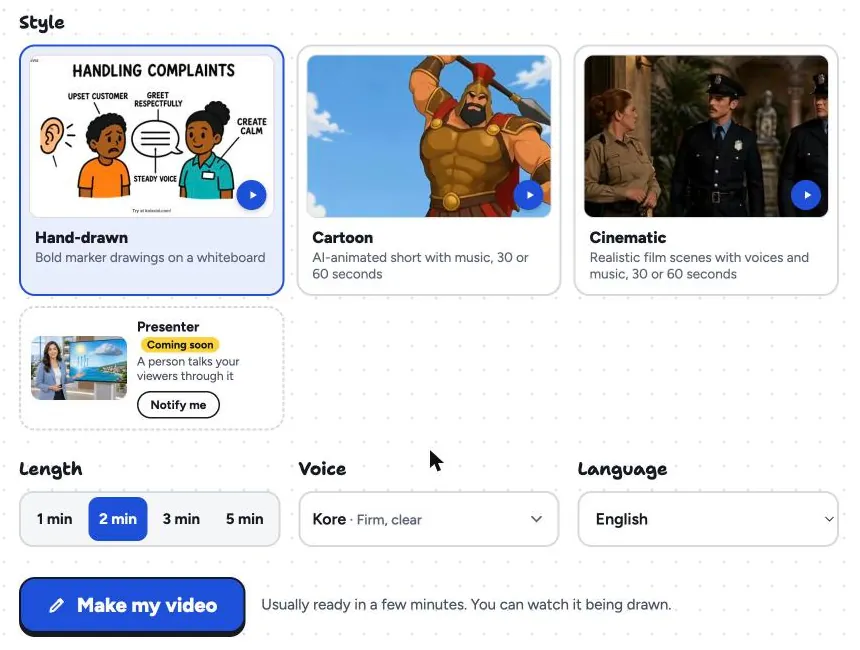
Choose a voice, a narration language and a length. A three-minute scenario needs a paid plan, since free videos run up to 2 minutes and paid plans up to 5. The video is usually ready in a minute or two. You get a narrated, drawn explanation, not acted footage: there are no presenters or avatars, so if you want filmed role-plays, use a camera for those. There is also no editing timeline, so you change the script and make it again. Download the MP4 for your LMS or share a link. The training page has sample videos.
FAQ
What topics should leadership training videos cover?
Start with the moments new managers meet in their first three months: first one-to-ones, feedback on good work and on work that needs to change, delegation, and the first difficult conversation. Add HR process videos, such as absence conversations, based on your own policies.
Can leadership training videos replace workshops?
Not on their own. Videos give everyone the same model and are easy to rewatch, but managers learn these skills by practising them. Use the videos as preparation for practice, coaching or a real conversation.
How long should a leadership training video be?
Two to four minutes for one moment. A scenario with a situation, the approach and example words fits comfortably in three minutes. Longer topics usually cover more than one moment and are better split.
Who should review HR training videos?
HR should check anything that touches policy, such as absence, performance or complaints. An experienced manager should check that the scenario and the example words sound realistic for your workplace.
Make the conversation everyone avoids first
Ask a few recent first-time managers which conversation they put off longest. Write that scenario with the five-part shape, including the first sentence they could say, and share it before your next new-manager session.